How can I help my car last longer
How can I help my car last longer
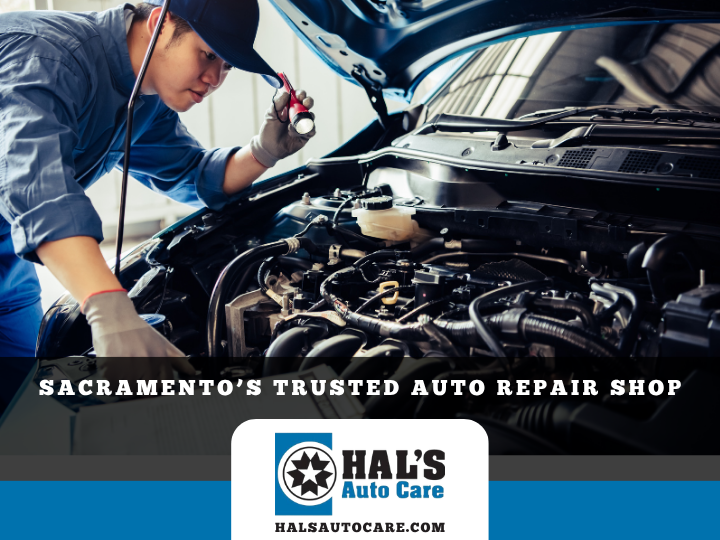
How to Make Your Car Last Longer: A Sacramento Driver's Guide to Smarter Vehicle Care
There is a version of vehicle ownership that most people never quite experience — the one where the car simply works, year after year, without the dread of unexpected repair bills, without the anxiety of wondering what that new noise means, and without the slow financial drain of a vehicle that is always on the edge of the next problem. That version of ownership is not about luck, and it is not reserved for people who buy new vehicles every few years. It is built deliberately, through consistent decisions made with accurate information and a genuine understanding of what a vehicle needs to stay reliable over the long run.
If you drive in Sacramento, Carmichael, Arden-Arcade, Fair Oaks, Citrus Heights, or anywhere along the Tower Avenue corridor and into the broader Sacramento metropolitan area, you already know the conditions that come with living in the Central Valley. Summers that arrive with sustained, intense heat — weeks at a time above 100 degrees in the Sacramento basin — that push engine cooling systems, batteries, belts, and rubber components harder than most vehicle owners realize. Valley tule fog through the winter months that coats surfaces with moisture and creates cold-start conditions that stress engines and electrical systems. The stop-and-go demands of Watt Avenue, Exposition Boulevard, and the approaches to US-50 and I-80 that cycle engines through partial warm-up conditions day after day without reaching the steady-state operation they were designed for. Seasonal air quality events that load air filtration systems faster than drivers in cleaner-air environments would expect.
Every one of those conditions has a specific mechanical effect on your vehicle. Understanding those effects — and responding to them intelligently, before problems develop — is what separates the vehicles that reach 200,000 reliable miles from the ones that become an ongoing financial burden. This guide exists to give you that understanding, written with one clear priority: your genuine long-term interest, not a service revenue agenda.
The Foundation: Your Vehicle Is a System, Not a Parts List
Before any individual maintenance item can be fully appreciated, one concept has to be clearly in place: your vehicle is an interconnected system, not a collection of independent components. Every part is connected to something else. Every fluid serves multiple functions simultaneously. Every small neglect creates a downstream consequence that compounds over time and shows up later as something that looks unrelated to its original cause.
The way this plays out in practice is worth understanding concretely. When engine oil degrades past its effective service life, friction increases at every contact surface inside the engine. Increased friction generates additional heat. That additional heat puts greater load on the cooling system. The cooling system working harder depletes coolant chemistry faster. Depleted coolant becomes acidic. Acidic coolant begins attacking aluminum components — cylinder heads, water pump housings, heater cores, radiator tubes — from the inside. Meanwhile, the elevated operating temperatures accelerate the breakdown of every seal and gasket in the engine. None of this produces a warning light. None of it feels different to the driver. It accumulates silently over months, and when something finally becomes visible as a symptom, the cascade has been running for a long time.
This is not a rare sequence. This is the standard pattern of how vehicles deteriorate when maintenance is reactive rather than proactive. Understanding it changes how you think about every item in this guide — not as isolated services, but as the deliberate management of a system that depends on all of its parts working together.
Engine Oil: The Single Greatest Determinant of Engine Longevity
No maintenance decision has a greater impact on how long an engine lasts than the consistency and quality of engine oil maintenance. And no maintenance item is more consistently misunderstood in terms of what it actually does and why it matters as deeply as it does.
Engine oil lubricates the contact surfaces between moving parts operating under extraordinary pressure and heat. But lubrication is only the beginning of what oil does inside a running engine. It cleans internal surfaces by suspending combustion byproducts, metallic wear particles, and contaminants and carrying them to the filter where they can be captured and held. It cools areas of the engine that the liquid cooling system cannot physically reach — piston undersides, valve train contact surfaces, main and rod bearing surfaces — by absorbing heat and circulating it away from those surfaces. It neutralizes the acids that form as a direct byproduct of the combustion process. It maintains a protective film between metal surfaces that prevents contact under the forces that exist during operation.
As oil ages through heat cycling and accumulated use, every one of those functions degrades progressively. The base oil oxidizes and thickens. The additive package — the chemistry responsible for cleaning capacity, acid neutralization, anti-wear performance, and film strength — depletes with use and cannot be replenished without a fluid change. The oil picks up contaminants it can no longer fully suspend, eventually depositing them as varnish on internal surfaces. What was engineered to protect a complex mechanical system becomes a fluid that is actively working against it.
The specific oil and interval right for any given vehicle depends on factors that are genuinely variable by driver. In Sacramento's climate, oil type matters enormously. Full synthetic oil offers significantly better thermal stability than conventional oil — a critical advantage when engine compartment temperatures on a Sacramento summer afternoon can easily reach 230 to 250 degrees Fahrenheit or higher. Synthetic oil maintains its viscosity characteristics and its protective film strength across wide temperature extremes in ways that conventional oil cannot match, providing better protection during the cold tule fog mornings of December and January and dramatically better protection during the sustained heat of July and August.
Driving patterns are equally important and sometimes more telling than odometer readings alone. Short trips — running errands along Fair Oaks Boulevard, brief commutes through the Arden-Arcade corridor, back-and-forth trips through the Tower District that never exceed fifteen minutes — prevent an engine from reaching and holding full operating temperature. When an engine runs cold or partially warm, moisture and combustion byproducts that would burn off under sustained heat cycling instead accumulate in the oil. An engine doing exclusively short local trips can have chemically compromised oil well before the mileage interval suggests it needs attention. A shop that genuinely serves your interest asks about how you actually drive before making a recommendation — not just what vehicle you own.
Fluids: The Interconnected Network Every System Depends On
Engine oil is the most discussed fluid in vehicle maintenance, but it operates within a broader network of fluids, each serving critical functions, each degrading with time and use in ways that have direct consequences for the components they are protecting.
Coolant manages engine temperature, but its function extends well beyond simple heat transfer. Coolant contains a corrosion inhibitor package that protects aluminum components — cylinder heads, water pump housings, heater cores, and the internal passages of the radiator — from the electrochemical corrosion that occurs when dissimilar metals are in contact with water-based fluid. Those inhibitors deplete over time. As they deplete, the coolant becomes increasingly acidic and progressively more aggressive toward the aluminum surfaces it was designed to protect. In Sacramento's climate, where cooling systems work under sustained thermal load for months at a time and where summer heat regularly pushes the limits of what cooling systems were designed to manage, coolant chemistry matters more than it would in a milder climate. A cooling system operating on degraded coolant is also at greater risk during the freeze events that do occasionally affect the Sacramento area in December and January — properly maintained coolant has a lower freeze point than depleted coolant, and that difference matters on the coldest nights of a Central Valley winter.
Brake fluid absorbs moisture from the surrounding atmosphere continuously, regardless of how often the vehicle is driven or how recently it was last serviced. As moisture content increases, the boiling point of the brake fluid decreases in a predictable and measurable way. Brake fluid with too much absorbed moisture can boil under the heat generated by hard or repeated braking — the kind that happens in stop-and-go traffic on Watt Avenue, on the descent from elevated freeway sections of US-50, and in the school zone corridors that run through residential Sacramento neighborhoods. When brake fluid boils, it creates vapor that compresses in ways liquid cannot, producing a soft, inconsistent pedal and dramatically reduced stopping capability at the moment stopping capability is most needed. Fresh brake fluid with a high boiling point is a safety investment with a direct, measurable return in consistent and reliable braking performance.
Transmission fluid lubricates the gear surfaces, clutch packs, and bands of the transmission while also providing the hydraulic pressure that enables smooth, controlled gear transitions. Heat and mechanical shear degrade the fluid's lubricating properties over time, and a transmission operating on degraded fluid experiences accelerated internal wear that progresses silently. By the time rough shifting, delayed engagement, or slipping become noticeable symptoms, significant internal damage has already accumulated. Transmission rebuilds and replacements are among the most expensive repairs in automotive service, and most of them trace directly to fluid that was not serviced when the vehicle's condition warranted it.
Power steering fluid lubricates the power steering pump and rack components. Differential fluid protects the gear sets that transfer power to the driven wheels. Transfer case fluid in four-wheel and all-wheel drive vehicles manages torque distribution between axles. Each of these fluids follows the same pattern without exception: they degrade with use and time, they protect components that are expensive to replace, and they deserve genuine condition assessment rather than assumptions based on mileage alone.
Tires: The Four Points Where Everything Meets the Road
Every ounce of power your engine produces, every pound of braking force your system applies, every steering correction your hands make at the wheel — all of it is transmitted to the road through four contact patches of rubber, each roughly the size of an open hand. What happens at those four points determines everything about how your vehicle behaves under real-world conditions. The rest of the vehicle exists to deliver force and information to those four points as effectively as possible.
Tire pressure is the most impactful and most frequently neglected maintenance variable in everyday vehicle ownership. Tires lose pressure naturally over time — approximately one PSI per month under normal conditions — and lose it more rapidly with significant temperature changes. In Sacramento, the diurnal temperature swing between cool Delta-breeze evenings and hot afternoon temperatures creates meaningful daily pressure variation, particularly in spring and fall. Drivers who check tire pressure infrequently are often running significantly outside the correct range without any obvious indication that anything is wrong.
Underinflated tires flex excessively through the sidewall, generating heat that accelerates internal structure fatigue and shoulder tread wear, reducing fuel economy measurably, and compromising wet-weather handling and braking. When Sacramento's winter rain season arrives and roads in the city, in Carmichael, and along the American River Parkway corridor become wet for extended periods, properly inflated tires perform significantly better under braking and cornering than underinflated ones. Overinflated tires reduce the contact patch and lower wet traction while producing uneven center-tread wear that shortens overall tire life. The correct pressure is listed on the sticker inside the driver's door jamb — not the maximum rating molded into the tire sidewall — and should be verified with a quality gauge when the tires are cold.
Tire rotation distributes wear evenly across all four tires, extending the useful life of a complete set significantly. Front tires carry the engine's weight, manage all steering forces, and on front-wheel drive vehicles also handle acceleration loads — causing them to wear faster and in different patterns than rear tires. Consistent rotation prevents any single tire from becoming the limiting factor that forces full-set replacement before the other tires are ready.
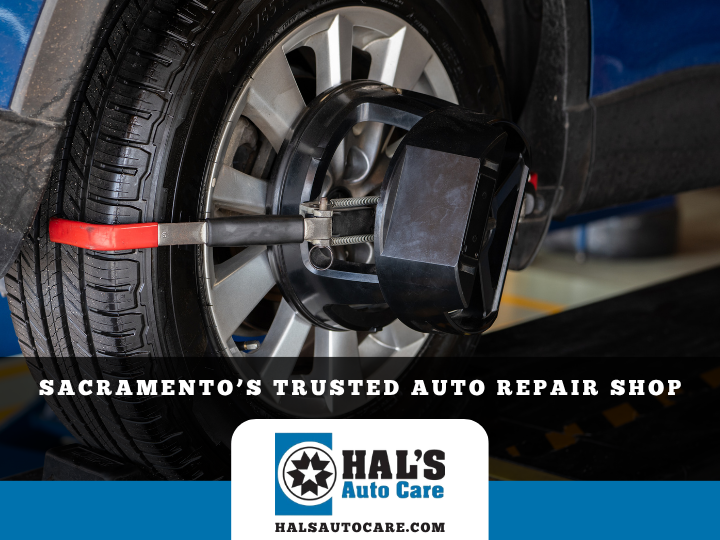
Wheel alignment ensures that all four tires meet the road at the correct angle, producing uniform tread wear across the full tread surface and predictable handling under braking, cornering, and acceleration. Sacramento's road surfaces vary considerably — from well-maintained freeway surfaces on I-80 and US-50 to older surface streets in established neighborhoods throughout Arden-Arcade, Carmichael, and the Tower District that have experienced years of utility cuts, patching, and seasonal stress. Curb impacts, pothole strikes on deteriorated surface streets, and road edge contacts can knock alignment out of specification without producing any immediate handling symptom that a driver would notice. The evidence accumulates gradually as uneven tread wear that shortens tire life and compromises handling and safety.
Tire condition deserves a genuine evaluation at every service visit, not a quick visual confirmation that the tires have tread remaining. Tread depth across the full width of the tire — center, intermediate, and shoulder — tells a more complete story than a center measurement alone. Sidewall condition including cracking and ozone degradation, which is relevant for vehicles parked outdoors through Sacramento's intense UV summers. Evidence of impact damage, bubbling, or abnormal wear patterns that indicate inflation, alignment, or balance issues that have been progressing undetected.
Brakes: What Genuine Protection Actually Requires
The standard reactive approach to brake maintenance — replace the pads when the wear indicator produces a squeal or the warning light illuminates — is the most common approach and consistently produces more expensive outcomes than proactive attention would have.
Brake pads are the designed-to-wear consumable element of the braking system. They sacrifice themselves so that the rotors, calipers, and hardware beneath them do not have to. When pads wear past their effective limit, the metal backing plate contacts the rotor surface and the damage that follows is rapid. Rotors that could have been resurfaced at modest cost now need full replacement. Hardware that could have been reused is distorted or damaged. A routine pad replacement becomes a substantially more involved and more costly service that could have been avoided with earlier attention.
Beyond pad thickness, a complete brake inspection examines the surrounding components that make the system function. Brake calipers apply and release clamping force on the rotor through hydraulic pressure — when caliper pistons or slide pins seize due to corrosion or degraded seals, they hold constant, uneven pressure on one side of the rotor. The result is asymmetric wear, a pull under braking, and heat buildup that accelerates deterioration throughout the system. Brake hoses can deteriorate internally while appearing intact on the outside — a collapsed internal passage creates a partial blockage that traps hydraulic pressure and effectively holds a brake partially applied. Brake lines can corrode at fittings and in areas where moisture and road debris accumulate, a concern that applies to Sacramento vehicles despite the region's dry reputation, because of the tule fog moisture that saturates undercarriage surfaces through the winter months.
Brake fluid condition — specifically its moisture content and remaining effective boiling point — is a safety variable, not an aesthetic or cosmetic one. A complete brake inspection addresses all of these elements. That comprehensive view is what actually protects both safety and long-term maintenance budget.
Belts, Hoses, and the Components That Fail Without Warning
There is a category of vehicle components that deteriorates gradually and without obvious symptoms, gives very little warning of impending failure, and then fails in ways that strand vehicles and cause collateral damage to surrounding components.
The serpentine belt drives the alternator, power steering pump, air conditioning compressor, and water pump simultaneously from the engine's crankshaft. When it breaks — and in Sacramento's heat, belt degradation accelerates compared to cooler climates — all of those systems stop together. A serpentine belt failure that stops the water pump while a vehicle is in traffic on Watt Avenue in July creates an overheating situation within minutes and real potential for collateral engine damage. Inspection of belt condition, including the ribbed underside where cracking, glazing, and chunk-out first appear, provides information that mileage tracking cannot deliver.
The timing belt, in engines equipped with one, synchronizes the crankshaft and camshaft rotation. Failure of a timing belt in an interference engine design can cause internal component contact that produces catastrophic, often non-repairable engine damage. The service interval for a timing belt is not a recommendation to consider — it is a scheduled replacement deadline. Sacramento's sustained heat accelerates rubber degradation in ways that make adherence to timing belt intervals more important than it would be in more temperate climates.
Radiator and coolant hoses carry pressurized coolant through the engine and heater system through constant thermal cycling. In Sacramento's climate, where the temperature difference between a foggy January morning and a July afternoon can exceed 80 degrees, the cumulative fatigue of that thermal cycling on hose rubber adds up rapidly. Hoses develop soft spots, swell internally, and harden at the ends near clamps in ways that visual inspection does not reveal. Squeezing a hose and assessing its feel — firmness, the presence of soft spots, compliance under pressure — provides a genuine condition assessment.
Vacuum lines, PCV hoses, and accessory drive components throughout the engine compartment age through the same heat and UV exposure processes that affect every rubber component in Sacramento's environment. A few minutes of genuine under-hood inspection during a routine service visit finds these issues while they are inexpensive to address — before they become the reason a vehicle is sitting on the shoulder of I-80 waiting for a tow truck.
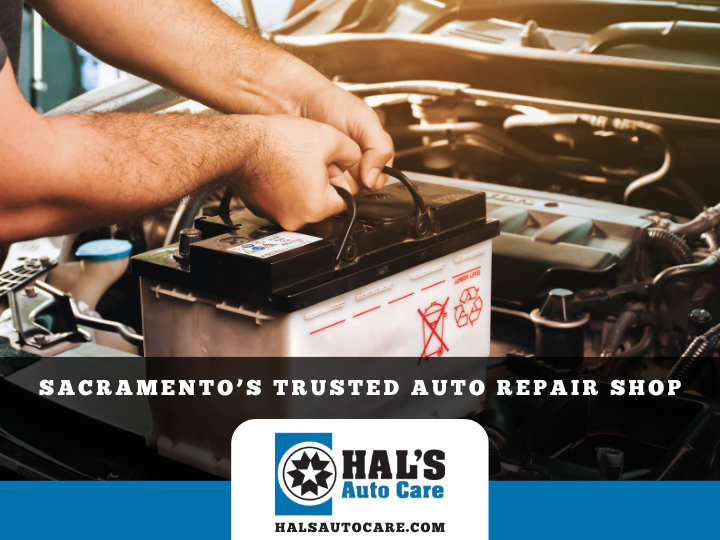
Battery and Charging System: Heat Is the Enemy Most Drivers Do Not See Coming
Most drivers associate battery failure with cold weather, and that association is not wrong — cold temperatures increase cranking load and expose weak batteries quickly. But sustained heat is actually the greater long-term enemy of battery capacity, and Sacramento's climate delivers that heat in quantity across a long season.
High temperatures accelerate the internal chemical processes that cause a battery to degrade. A battery in Sacramento's climate experiences more cumulative heat stress over the course of its service life than the same battery would in a cooler environment, and it typically reaches the end of its effective service life sooner as a result. The problem is that the degradation is invisible until the battery fails — and it often fails on a hot summer afternoon in a parking lot along Howe Avenue or Arden Way, not during a cold morning when a driver might expect battery trouble.
A battery that reads full voltage at rest can still fail under the cranking load required to start a heat-soaked engine. Load testing — applying a measured electrical draw and observing the battery's voltage response under that load — provides a genuine picture of remaining capacity that a resting voltage reading cannot. A battery showing reduced load capacity at two-thirds of its expected service life deserves to be understood as such, so that replacement happens on a planned schedule rather than in an urgent situation.
The alternator that charges the battery and powers the vehicle's electrical systems while the engine runs should be verified for proper output during any battery service. Corroded terminals, damaged cables, and loose connections create circuit resistance that reduces effective voltage delivery even from a healthy battery and alternator. These are simple and inexpensive corrections that make a meaningful difference in electrical system reliability through Sacramento's demanding summers.
Air Filtration: Clean Combustion, Clean Cabin
The engine air filter protects the intake system and combustion chamber from airborne contaminants. In Sacramento and the Central Valley — where summer air quality events driven by wildfire smoke and valley air stagnation load particulate matter into the atmosphere, where agricultural dust moves through the region seasonally, and where urban traffic on major corridors generates consistent combustion particulates — engine air filters earn their replacement interval faster than they might in cleaner air environments. A restricted air filter disrupts the air-fuel mixture the engine management system requires for efficient combustion, reducing power output, increasing fuel consumption, and forcing compensatory adjustments that create downstream effects.
The cabin air filter cleans the air moving through the HVAC system before it reaches the passenger compartment. In Sacramento, where wildfire smoke events have become a recurring seasonal reality and where summer air quality advisories are a regular part of life, the cabin air filter is not merely a maintenance item — it is a meaningful daily health consideration. A degraded cabin filter also reduces airflow through the HVAC system, forces the blower motor to work harder, reduces heating and air conditioning effectiveness, and shortens the blower motor's service life. Both filters are inexpensive and impactful. Both are frequently overlooked until the consequences become obvious.
The Shop That Makes All of This Possible
Every piece of guidance in this article ultimately depends on one thing that cannot be purchased separately and cannot be substituted with a coupon or a lowest-price search: a shop that genuinely has your long-term best interest at heart.
Not a shop that generates the longest possible recommended service list on every visit. Not a shop that creates urgency around services that may not be timely for your specific vehicle. A shop that looks at the actual condition of your vehicle, understands how you use it, and tells you the truth — what needs attention now, what deserves monitoring over the coming months, and what can wait without meaningful risk.
That kind of shop builds a genuine service history for your vehicle — a complete record of what has been done, when, and why — that allows each future service visit to build on an accurate picture of the vehicle's health rather than starting from scratch. It makes recommendations grounded in real findings, not in a standardized service menu. And it earns your trust not by being pleasant, but by being consistently and genuinely honest — including when honesty means telling you that your vehicle looks good and does not need anything today.
For drivers in Sacramento, Carmichael, Arden-Arcade, Fair Oaks, Citrus Heights, and the surrounding communities of the greater Sacramento area, Hal's Auto Care is that kind of shop. Located at 2425 Tower Ave in Sacramento, their team brings genuine technical expertise and a consistent, clear commitment to doing right by the people who bring their vehicles in.
Reach them at (916) 485-9215, or visit halsautocare.com to learn more about their services or schedule your next appointment.
The Long Game: Every Mile Earned Through Consistent Attention
Vehicles that reach 200,000 reliable miles do not arrive there through luck or through any single significant repair. They get there because someone made a consistent series of good decisions — chose proactive attention over reactive response, sought accurate information over assumptions, and built a relationship with a shop that told the truth every single time.
Sacramento's roads and climate will test every system on your vehicle. Sustained summer heat will stress your cooling system, your battery, your belts, and every rubber component under the hood. Valley air events will load your filtration systems faster than the odometer suggests they should need attention. Tule fog mornings will test your electrical system and your cold-start protection. Stop-and-go traffic along Watt Avenue, Arden Way, Exposition Boulevard, and the US-50 and I-80 corridors will put daily demands on your engine, brakes, and transmission that accumulate faster than they appear to.
None of that is unmanageable. Every challenge described in this guide has a response — a maintenance action, a fluid service, an inspection, an honest conversation with a shop that will tell you what your vehicle actually needs and what it does not. Vehicle longevity is not complicated. It is not expensive relative to what neglect costs. It is consistent.
Take care of the vehicle that takes care of you. Do it with intention, do it with accurate information, and do it with a team that has genuinely earned your trust by deserving it. That is the formula — and it works every time it is actually followed.
You can watch the video