Burning Smell From Car in Sacramento, CA | Hal's Auto Care
Burning Smell From Car in Sacramento, CA | Hal's Auto Care
Burning Smell From Your Car in Sacramento, CA: What It Means for Gas, Hybrid, and Electric Vehicles
You have been on the Capital City Freeway for twenty minutes. You take the exit, roll up to the red light at Arden Way, and a hot, unfamiliar smell comes through the vents. By the time you are moving again it is gone, and you spend the rest of the drive wondering whether you imagined it.
You probably did not. A burning smell from your car is a real signal, and it is worth understanding. In most cases the cause is modest: a small fluid leak reaching a hot surface, a brake that is dragging, a belt that is slipping. In a few cases it means the vehicle should not be driven any farther. What it means also depends on what you drive. A gasoline car, a hybrid, and an electric vehicle have different parts that can overheat, and Sacramento has a great many of all three on the road.
At Hal's Auto Care, our goal is to give you an honest assessment of what matters now and what can wait. This guide does the same thing in writing.
Now, Soon, or Later: How Urgent Is It?
Three questions sort almost every burning smell into the right category.
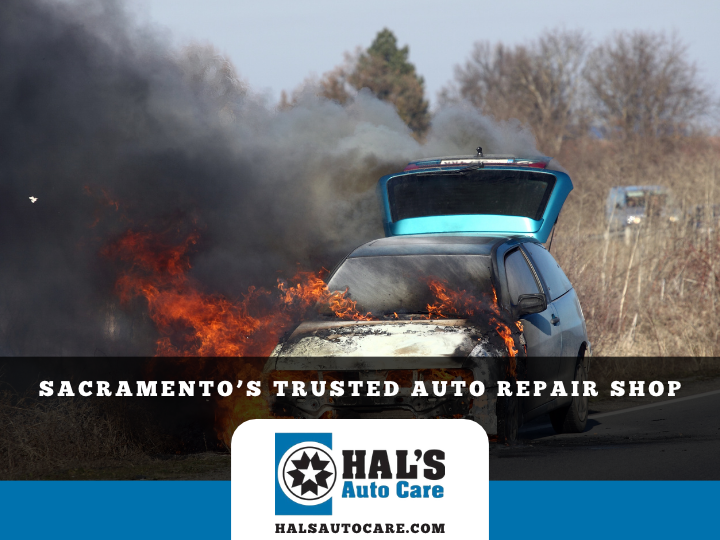
Is there smoke, or is the smell electrical and getting stronger? If yes, this is a "now" situation. Pull over where it is safe, shut the vehicle off, get everyone out, and move well away. Call 911 if you see smoke or flame. Do not open the hood. Avoid stopping over dry grass, because a hot exhaust can ignite it.
Is a gauge or warning light telling you something? A temperature gauge heading toward hot, a red warning light, a battery or charging warning, or a brake pedal that feels different all move the problem into the "now" category as well. Stop and arrange a tow instead of pressing on.
Is it faint, steady, and unaccompanied by anything else? If the gauges are normal, there is no smoke, and the vehicle drives and stops as it always has, it belongs in the "soon" category. Have it inspected in the coming days, and avoid long trips until you know what it is.
There is a small "later" category too. A dusty smell for a few minutes the first time you use the heater in the fall, or a light odor for a day after an oil change or new brakes, generally resolves without any repair. If it does not fade, it moves up to "soon."
Why You Notice It at the Off-Ramp
The pattern in the opening of this article is one we hear constantly, and it has a straightforward explanation.
At freeway speed, the engine and exhaust are working steadily and running at full temperature, and a strong flow of air moves through the engine compartment and out under the vehicle. Any fumes are swept away behind you. When you exit and stop, the airflow drops to almost nothing while every part is still at its hottest. Heat and vapor rise from the engine compartment, and the fresh-air intake for the ventilation system, located at the base of the windshield, draws them into the cabin.
So a smell that appears just after freeway driving and fades once you are moving again usually points under the hood, most often to a fluid reaching a hot surface. It is the timing, more than the smell itself, that gives it away.
Gasoline Vehicles: The Usual Causes of a Burning Smell From Your Car
Most vehicles on Sacramento roads still have a gasoline engine, and the causes are well understood.
Oil on the exhaust
A sharp, bitter smell, sometimes with a trace of blue-gray smoke under the hood, is oil burning off a hot exhaust part. Gaskets harden with age and heat, and the gasket at the valve cover on top of the engine is the most frequent source. A little oil spilled during an oil change can cause the same smell for a day or so. A leak that continues should be repaired, since it lowers the oil level, damages rubber parts, and places a flammable fluid on the hottest part of the vehicle.
Coolant on the engine
Coolant smells sweet. When it escapes onto hot metal, it flashes to steam, and many drivers describe that as burning. Check the temperature gauge whenever you notice a sweet smell. An engine that overheats can be badly damaged in a short distance.
A slipping belt
Burning rubber, often with a squeal, points to the drive belt that runs the alternator, air conditioning compressor, and other accessories. Belts slip when they are worn or contaminated, or when one of the parts they drive is starting to bind.
Hot brakes
A harsh, acrid odor near a wheel means that brake is overheating. Heavy use on a long downgrade will do it. On level city streets, the more likely cause is a caliper that is not releasing. The affected wheel will be far hotter than the others, so look and smell, but do not touch.
Overheated transmission fluid
Transmission fluid that has been overheated or is leaking onto the exhaust has a burnt odor that is harsher than oil. It deserves prompt attention, because fluid condition is the first indicator of a transmission's health.
Electrical heat
A smell of hot plastic from the vents or dash points to wiring, a connector, or a motor such as the cabin fan. A fuse that keeps blowing is part of the same story. Never replace a fuse with a larger one. The fuse is protecting the wiring.
Something on the exhaust
A plastic bag or road debris melted onto the exhaust pipe smells awful but is usually harmless and burns away. It is strongest outside and underneath the vehicle.
Hybrids: What Is Different
A hybrid has everything a gasoline car has, plus a high-voltage battery, an electric motor, and the electronics that manage them. That changes how some problems show up.
The engine comes and goes. The gasoline engine in a hybrid shuts off and restarts on its own. A smell from an oil or coolant leak may therefore appear and disappear in a way that seems unrelated to anything you are doing.
The brakes do less work. A hybrid slows mostly by using its electric motor as a generator, which recharges the battery. The conventional brakes are used far less. That extends pad life, but brakes that are seldom worked hard are more prone to rust and to sliding parts that stick. A sticking brake can produce a burning smell on a hybrid whose pads look nearly new.
There is more than one cooling system. Most hybrids use a separate coolant loop for their power electronics. A leak there produces the same sweet smell as an engine coolant leak, and it is just as important to repair.
The battery needs airflow. Many hybrids cool the high-voltage battery with cabin air drawn through a vent near the rear seat. If that vent is blocked by bags, blankets, or pet hair, the battery runs warmer than it should. Keeping that vent clear is simple and worthwhile.
If a hybrid produces a hot electrical or chemical smell, particularly with a warning message on the dash, stop driving it and have it towed.
Electric Vehicles: Fewer Sources, but Still Worth Knowing
An electric vehicle has no engine oil, no exhaust system, and no drive belts, so many of the classic causes simply do not exist. A burning smell from an EV narrows to a shorter list.
Brakes
Like hybrids, EVs do most of their slowing electrically. Their conventional brakes can corrode and stick from lack of use, and EVs are heavy, which adds to the heat when the friction brakes are called on. An acrid smell from one wheel is a brake concern on an EV just as it is on any other vehicle.
The cabin heater
Many EVs heat the cabin with electric heating elements. The first use after a long, dusty Sacramento summer can produce a brief toasted smell as dust burns off. It should clear in a few minutes.
Coolant
EVs use liquid coolant for the battery and electronics. A sweet smell, or a coolant warning, should be checked promptly.
Charging equipment
This is the one most owners do not think about. A hot plastic smell at the charging port, the charging cable, or the wall outlet during charging means a connection is overheating. Stop charging. If you charge from a household outlet, a worn or undersized outlet is a common culprit and should be inspected by an electrician before it is used again. If the heat is at the vehicle's charge port, have the vehicle inspected.
The one that is an emergency
If an EV or hybrid produces smoke, a sharp chemical smell, or popping or hissing sounds from the battery area, get everyone out and move far away from the vehicle, then call 911. Battery fires are rare, but they are serious and should be left to the fire department.
How Sacramento Conditions Contribute
The valley's climate and geography shape these problems in specific ways.
Long, very hot summers. Month after month of high afternoon temperatures ages rubber and plastic. Gaskets, hoses, belts, and wiring insulation all harden with heat. Many of the oil seeps we find in the fall got their start over the summer.
Dry season. For much of the year, grass along road shoulders and in unpaved lots is dry. Parking a vehicle with a hot exhaust over it is a fire hazard in itself, separate from any mechanical problem.
Rain and fog season. When the winter rain and valley fog arrive, heaters and defrosters come on for the first time in months, which is when the dusty heater smell appears. Brake rotors also develop a light film of rust overnight in damp weather. A faint scraping on the first stop or two of the morning is normal. A smell or a pull that stays with you is not.
Short trips and freeway runs. A typical week might include short errands along Fulton Avenue and Watt Avenue, then a run up I-80 toward Roseville or out US 50 to Rancho Cordova. Short trips with frequent stops are hard on brakes and batteries. Freeway driving brings everything to full temperature and reveals the leaks.
Trips to the Sierra. A drive to the mountains means a long climb and a long descent. Coming home, use a lower gear and avoid riding the brakes, which overheats them. Hybrid and EV owners should know one more thing: when the battery is fully charged, the vehicle cannot recover as much energy while slowing, so the conventional brakes do more of the work. If you charge to full at the top of the mountain, expect the brakes to work harder on the way down, and descend accordingly.
Older Vehicles and the Smell You Have Gotten Used To
Many of our customers drive vehicles they have owned for a long time, and we are glad they do. A well-maintained older vehicle is one of the best values in transportation.
Older engines often have minor seepage at a gasket or two, and a faint smell after a hot drive can become part of the background. The thing to watch for is change. A smell that is stronger than it used to be, that shows up sooner, that now comes with visible smoke, or that is joined by a drop on the driveway or a lower reading on the dipstick is telling you the situation has moved.
Not every seep on an older vehicle needs to be repaired right away. Some can be monitored responsibly for a long time. The value of an inspection is knowing which ones those are.
What Happens When a Burning Smell Is Ignored
The outcomes follow from the causes. An oil leak that is ignored lowers the oil level until the engine is at risk, and it softens the belts, hoses, and mounts it drips on. A coolant leak ends with an overheated engine. A dragging brake destroys its pads and rotor and reduces stopping power on that wheel. Burnt transmission fluid stops protecting the transmission. An overheating electrical connection damages the wiring and components around it and, at worst, starts a fire.
What these have in common is that each one is small at the stage where it first produces a smell.
What a Thorough Diagnosis Includes
A good diagnosis begins with your account. When does it happen? After freeway driving, in stop-and-go traffic, while charging, with the heater on? Where does it seem to come from? Has anything been done to the vehicle recently?
The technician then checks every fluid for level and condition, inspects the engine, transmission, and cooling system from above and below for fresh leaks and for residue on hot parts, and examines belts and hoses. Each brake is checked for free movement and even wear. If the smell points to the electrical system, the relevant circuits and connectors are inspected and tested under load. A scan of the vehicle's computers looks for stored fault codes, which on hybrids and EVs can include temperature and battery system data that are not visible any other way.
You should come away with a clear explanation of the cause, how urgent it is, and what your options are. [link to diagnostic testing page]
Cost, Timing, and Long-Term Value
There is no single cost for a burning smell, because the smell is a symptom. What you can know in advance is what shapes the cost.
The stage at which it is found. A gasket found early is a gasket. Found late, it may come with a belt, hoses, or other parts the leaking oil has ruined. A sticking brake found early may need cleaning and hardware. Found late, it needs pads, a rotor, and possibly a caliper.
Labor to reach the part. The same type of seal can be a short job on one engine and a long one on another.
The type of vehicle. Hybrids and EVs sometimes require additional safety procedures and specific parts.
Parts quality. Quality gaskets, brake components, and the correct fluids last longer in valley heat, which lowers the cost per mile over the years you own the vehicle.
A sound way to think about it: an inspection is one of the most cost-effective things you can do, because it turns an unknown into a decision. And when a repair is needed, protecting a vehicle that is otherwise in good condition is almost always far less expensive than replacing it. If your vehicle is still under a warranty, keep your service records in case a related question comes up.
How Hal's Auto Care Handles a Burning Smell
Hal's Auto Care has been family-owned since 1979. Over that time, the approach has stayed the same: find the cause, explain it clearly, and separate what needs attention now from what can be scheduled or simply watched.
We work on gasoline vehicles, hybrids, and EVs, and our services include brakes, electrical diagnosis and repair, engine diagnosis, and transmission service, which covers the systems behind nearly every burning smell. If the cause is minor, we will tell you so. If it is serious, we will show you why. Either way, the decision is yours, and you will have what you need to make it. [link to hybrid and EV service page] [link to brake repair page]
Frequently Asked Questions
Why does my car smell like burning after I get off the freeway in Sacramento? Everything under the hood is at full temperature after freeway driving, and when you stop, the airflow that was carrying fumes away disappears. Vapor from a small leak rises and is pulled into the cabin. It usually indicates a fluid reaching a hot surface and should be inspected soon.
Can an electric vehicle have a burning smell? Yes. The most common sources are brakes that are sticking, dust burning off the cabin heater, and overheating at a charging connection. Smoke or a sharp chemical smell from the battery area is an emergency. Get away from the vehicle and call 911.
My hybrid's brakes smell hot, but the pads were just checked and are fine. How? Pad thickness is only part of it. Because hybrid brakes are used lightly, the sliding hardware can rust and stick, causing a pad to drag. The brake needs to be inspected for free movement, not just pad wear.
How much does it cost to diagnose and fix a burning smell? The cost follows the cause. Some causes require no repair at all. Others are a modest gasket, belt, or brake service. Problems that have been left to damage other parts cost more. Diagnosis comes first so that the repair addresses the real problem.
Is it safe to drive to Tahoe if I have noticed a burning smell? Have it checked first. A long climb and descent places the greatest load on the cooling system, transmission, and brakes, and a small problem in the valley can become a breakdown on the grade, far from help. An inspection before the trip is far less trouble than a tow from the mountains.
Is a burning smell from the heater normal in the fall? A dusty, toasted smell for a few minutes on first use after summer is normal. If it continues on later drives, smells sweet, or smells like hot plastic, have it looked at.
My older car has always had a faint oil smell. Should I worry now? Pay attention to change. If the smell is stronger, more frequent, joined by smoke or drips, or the oil level is dropping faster, have it inspected. A stable minor seep can often be monitored, and an inspection will tell you which kind you have.
An Honest Assessment Is a Phone Call Away
A burning smell from your car is a question that deserves a clear answer. Whether your daily drive is Fair Oaks Boulevard in from Carmichael and Fair Oaks, I-80 from Citrus Heights and North Highlands, or shorter trips around Arden-Arcade and East Sacramento, we will find the cause and tell you plainly what it means.
Call Hal's Auto Care or schedule a visit, and drive with confidence again. [link to appointment scheduling page]
Hal's Auto Care
2425 Tower Ave, Sacramento, CA 95825
(916) 485-9215
You can watch the video